
Double cleansing thoroughly removes makeup, sunscreen, sebum, and the impurities that settle on your skin throughout the day. The first product primarily dissolves oil-based buildup, while the second washes away any remaining residue and leaves your complexion prepped for the rest of your skincare routine.
Double Cleansing: How It Works and When It’s Worth Doing
Added: 12-11-2026 in category: - author:

This method is particularly useful if you apply SPF daily, wear makeup, or live in a city. However, that does not mean everyone needs to use two cleansing products every evening. What matters is tailoring your routine to whatever ended up on your skin that day, as well as to your skin's individual needs.
Double cleansing removes different types of impurities
Double cleansing involves washing your face with two products in succession. Each one has a slightly different job:
- the first step dissolves makeup, sunscreen, sebum, and oil-based cosmetic residue,
- the second step removes traces of the first product along with sweat, dust, and other surface impurities.
In the classic version, you start with an oil-based product, such as a cleansing oil or cleansing balm. Next, you wash your face with a water-based cleanser—a gel, foam, or gentle emulsion.
Micellar water can also serve as the first step, especially if you dislike the texture of cleansing oils. While not a traditional oil cleanse, micellar water also helps remove makeup and impurities. Afterward, your skin should be washed with water and an appropriate gel or foaming cleanser.
!
Worth remembering: two steps do not mean washing twice with the exact same cleanser. Each product plays a distinct role—the first breaks down stubborn layers, while the second gently finishes cleansing the skin.
SPF, makeup, and urban pollution make evening cleansing even more important
Sunscreens are formulated to form an even, durable protective film over the skin. Some formulas are also resistant to water, sweat, and rubbing. While this helps them perform better throughout the day, they may require more thorough removal in the evening.
Foundations, BB creams, concealers, and other color cosmetics behave much the same way. Over the course of the day, their layer mixes with sebum, sweat, and dust. If you live in an urban area, fine pollutants, smoke, and particulate matter also settle onto your skin. A quick splash of water alone may not be enough to remove them properly.
Double cleansing helps prep your complexion for subsequent steps like toner, serum, or moisturizer. Still, there is no need to aim for a "squeaky-clean" feel. Severe tightness, stinging, and redness after washing are not signs of superior cleanliness—they can indicate that your cleansing routine is too harsh.
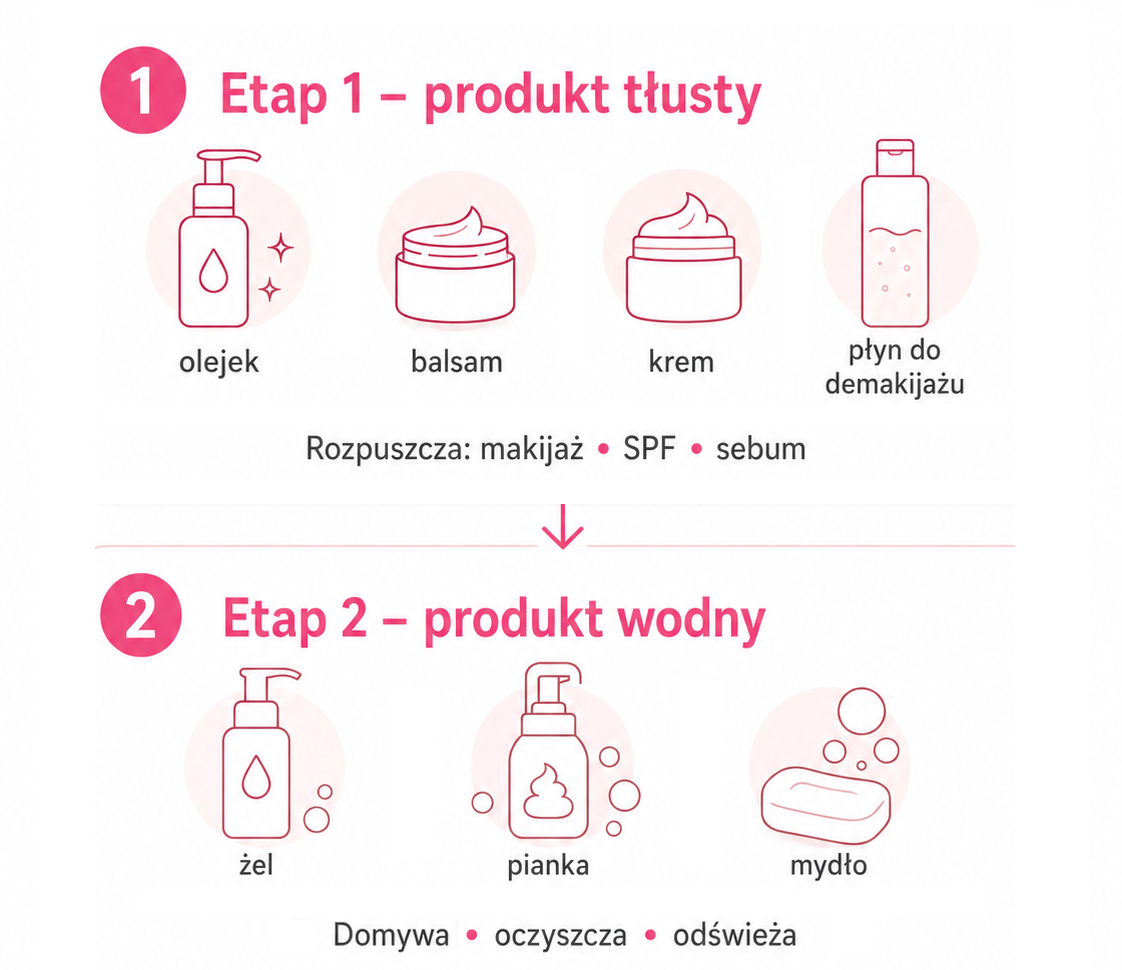
The first step dissolves makeup, sunscreen, and sebum
The first step typically relies on a cleansing oil, balm, butter, or micellar water. The product needs to bind with oil-soluble impurities that water alone cannot effectively wash away.
How you apply it depends on the specific product. Some oils are smoothed onto dry skin, while others—according to the manufacturer's instructions—are applied to damp skin. What matters most is distributing the product evenly and massaging gently, especially around the nose, hairline, temples, and jawline.
Emulsifying makes rinsing off cleansing oil much easier
Once makeup and sunscreen have dissolved, add a small amount of water. A cleansing oil containing an emulsifier will then change texture, turning into a light, milky fluid. This is the emulsification step, which helps the formula mix with water so it rinses away cleanly.
There is no need to massage your skin for ten or fifteen minutes. A brief, thorough massage with your fingertips is usually plenty. Afterward, rinse the product away thoroughly with lukewarm water and move on to the second step.
The second step finishes cleansing the skin and preps it for skincare
Once your makeup remover has been rinsed off, follow with a water-based cleanser—a foam, gel, or emulsion. Apply it to damp skin and work it in gently with your fingertips. You do not need facial brushes, rough sponges, or vigorous scrubbing.
Rinse the cleanser off thoroughly, paying attention to your hairline, the sides of your nose, and your jawline. Pat your face dry gently with a clean towel instead of rubbing. Once your skin is clean, you can follow with a toner, serum, and moisturizer matched to your skin's needs.
Proper double cleansing: makeup and SPF removal + emulsifying and rinsing + gentle washing with a gel or foam cleanser.
Ready-made duos make it easy to match cleansing to your skin type
The products used in both steps should suit your skin's needs. One pairing will work best for dry and reactive skin, while another is better suited to excess sebum and blackhead-prone skin.
If you have oily skin, there is no need to massage your face with gel for a long time or use a large amount. If using a deep-cleansing formula every evening leaves your skin feeling tight, use it less frequently or alternate it with a milder foam. Always adjust your routine to how your skin is currently responding.
Double cleansing is best done in the evening—and only when needed
The two-step approach is primarily meant for the evening. In the morning, there is no makeup or full-day layer of sunscreen on your skin, so a single gentle cleanser is usually enough—and for some dry skin types, simply rinsing with water works best.
Double cleansing does not have to be done every day. It is worth choosing when:
- you have been wearing makeup,
- you applied a generous amount of SPF or a water-resistant sunscreen,
- you spent a lot of time outdoors or in a polluted environment,
- your skin is coated in a mix of sweat, sebum, and skincare products.
If you spent most of the day indoors without wearing makeup or hard-to-remove products, a single gentle cleanser can be completely sufficient. More steps do not always translate to better results.
A clean towel and regularly changed pillowcases support cleansing results
Even well-chosen cleansers cannot replace basic hygiene. Keep a separate, soft towel exclusively for drying your face and swap it for a fresh one regularly. Gently pat the fabric against your skin rather than rubbing vigorously.
Changing your pillowcase regularly, washing makeup brushes and sponges, and cleaning items that frequently touch your face—such as your phone—also make a difference. During the day, try to avoid resting your face in your hands or touching your skin unnecessarily.
Double cleansing should never be a race to strip your skin of every trace of oil. Its goal is the thorough yet gentle removal of everything that has built up on your face over the day. With properly chosen products, you can achieve that balance whether your skin is dry and sensitive, oily and blemish-prone, or mature.
Find more tips on our blog: